Vendor-neutral implementation and assurance for sovereign AI
Build sovereign AI systems—and prove how they are controlled.
SovAIHub turns architecture and policy into private, portable, and auditable AI workloads across on-premises, cloud, Kubernetes/OpenShift, and air-gapped environments.
The controlled workload and evidence layer above your infrastructure.
Infrastructure platforms provide compute and deployment boundaries. SovAIHub focuses on what runs inside them: private RAG, approved artifacts, controlled agents, release evaluation, system evidence, and operating economics.
Control the boundary
Define where data, models, prompts, tools, and runtime services are allowed to operate.
Control the supply chain
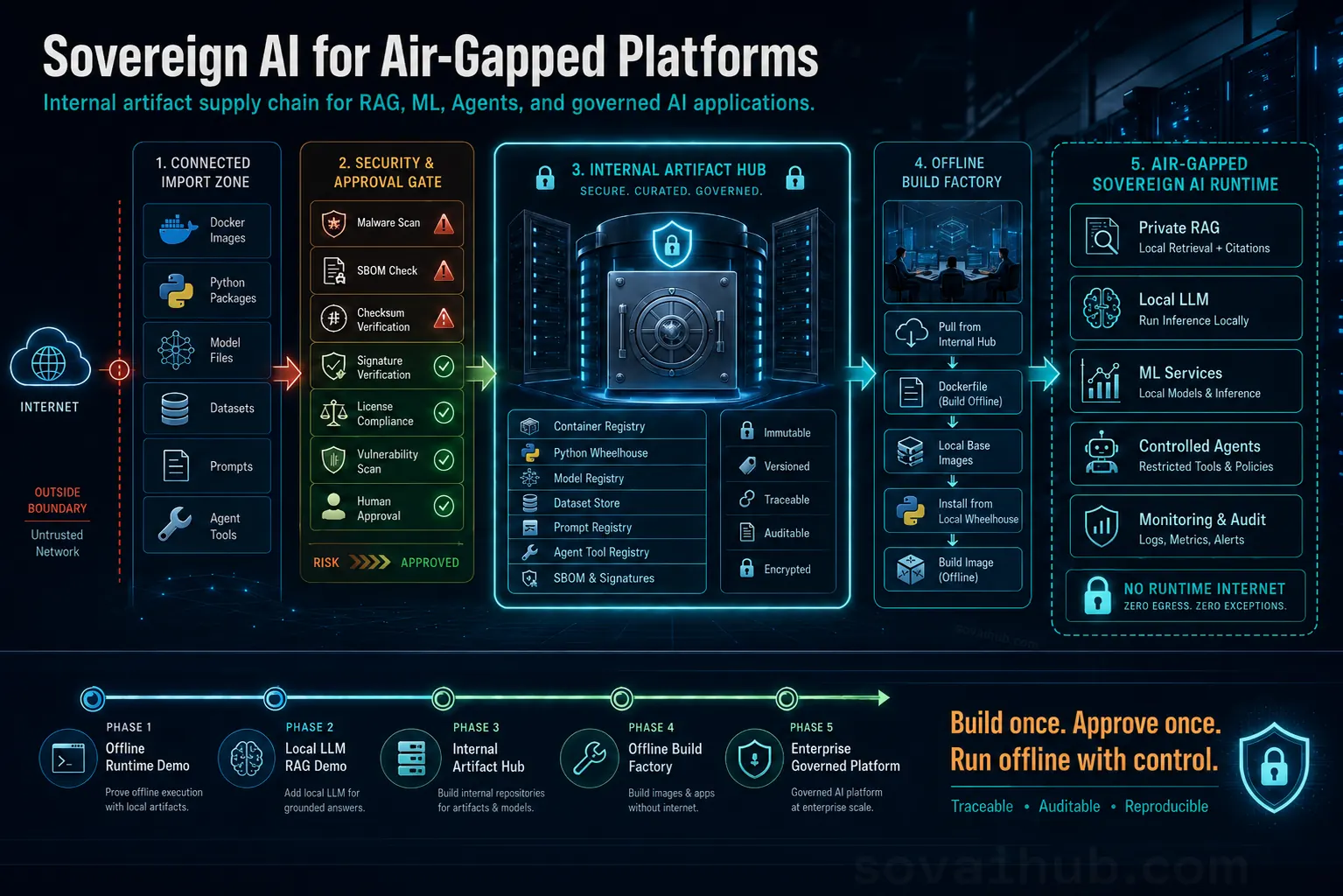
Use approved images, packages, models, prompts, and tools instead of uncontrolled public pulls.
Control the answer
Ground outputs in retrieved evidence, citations, validation rules, confidence checks, and escalation paths.
Control operations
Track latency, token use, model behavior, retrieval quality, tool calls, audit events, and deployment health.
Sovereign AI Assurance
Build it. Control it. Prove it.
Connect architecture and operations to explicit AI-SOV controls, retained evidence, and jurisdiction-specific mappings without confusing a product capability with an assurance result.
01
Build it
Design the sovereign boundary across data, models, inference, infrastructure, artifacts, agents, and networks.
02
Control it
Implement the requirements for your target level and expose dependencies that cap the result.
03
Prove it
Retain traceable configuration, test, recovery, ownership, and review evidence from the deployed system.
Open-source starting points for air-gapped and local AI systems.
Begin with working reference implementations, then adapt the patterns to your own data, infrastructure, model runtime, and governance requirements.
Open Source KitOpen Source
SovAI Air-Gap AI Starter
Open-source laptop-ready starter kit for demonstrating an air-gap-ready sovereign AI runtime with local documents, approved tools, offline Docker bootstrap, and audit logs.
Price
Free
Difficulty
beginner
Deployment
Docker Desktop / offline runtime
Assurance contribution
Supports air-gap, operational, security, and controlled-tool foundations.
Open-source local LLM RAG starter that runs private retrieval, grounded prompting, Ollama inference, citations, and audit logging without an external LLM API.
Price
Free
Difficulty
intermediate
Deployment
Docker Desktop / Ollama
Assurance contribution
Supports model, data, and inference sovereignty through local retrieval and local generation.
Open-source reference implementation for a controlled internal AI artifact supply chain with local registry, wheelhouse, prompt/tool manifests, approvals, and offline builds.
Free tools for readiness, compliance orientation, unit economics, evaluation, model choice, and hardware planning.
Use the resource library to assess readiness, orient AI Act classification, model fully loaded cost and value, select models, size hardware, and test RAG behaviour before production.
Technical guides on private RAG, sovereign AI, deployment patterns, observability, and practical enterprise AI architecture.
Sovereign AI6 min read
Your AI Data Stays Local. Who Controls Everything Else?
Trace the dependencies of a private RAG assistant on local GPUs, then use an evidence checklist to review access, telemetry, updates, continuity, and exit.
Operational SovereigntyPrivate RAGEvidenceLocal AI
EU AI Act Timeline After the 2026 AI Omnibus: What Engineering Teams Should Do
The 2026 AI Omnibus changed the high-risk AI timeline while Article 50 transparency duties still apply from August 2, 2026. Here is the current engineering-oriented map.
Hallucination Control in Enterprise RAG: A Production Engineering Guide
A senior engineer's framework for classifying, detecting, and systematically eliminating hallucination across the full RAG pipeline — from retrieval quality to atomic fact verification, NLI-based validation, and continuous production monitoring.
Private RAG for Enterprise Documents: Production Architecture in 2026
A senior engineer's guide to building enterprise-grade private RAG systems — covering advanced retrieval pipelines, access-layer design, agentic patterns, evaluation frameworks, and regulatory compliance.
SovAIHub is built by Rana Kumar from hands-on work across private RAG, model deployment, cloud-native platforms, observability, data systems, and AI governance. The focus is practical: patterns teams can understand, operate, and verify.